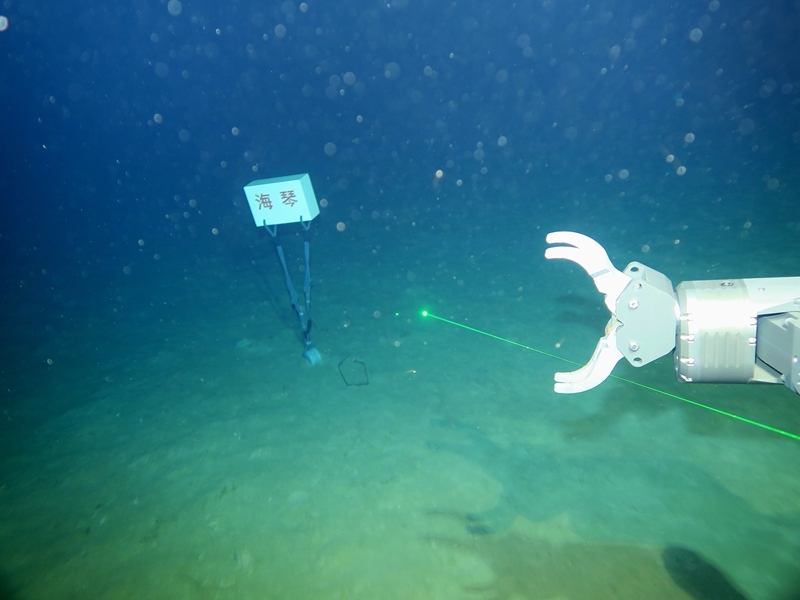
On August 23rd, the "Haiqin" placed a marker on the seabed at a depth of 4140 meters.
On the morning of August 23rd, in the dawn of the South China Sea, China's independently developed 6000 meter deep-sea unmanned remotely operated vehicle (ROV) "Haiqin" successfully conducted a sea trial from a depth of 4140 meters after 8 hours of operation, adding another "scientific research tool" to China's deep-sea research.
The "Haiqin" was independently developed by the Underwater Engineering Research Institute of Shanghai Jiao Tong University. It is a new and efficient deep-sea electric ROV system tailored for the "Sun Yat sen University" marine comprehensive scientific research internship ship. It is equipped with high-definition cameras, multifunctional robotic arms, detection sensors and other scientific research equipment, and has intelligent operation capabilities such as automatic orientation, hovering positioning, and automatic line patrol.
Xinhua News Agency (photo provided by Sun Yat sen University)
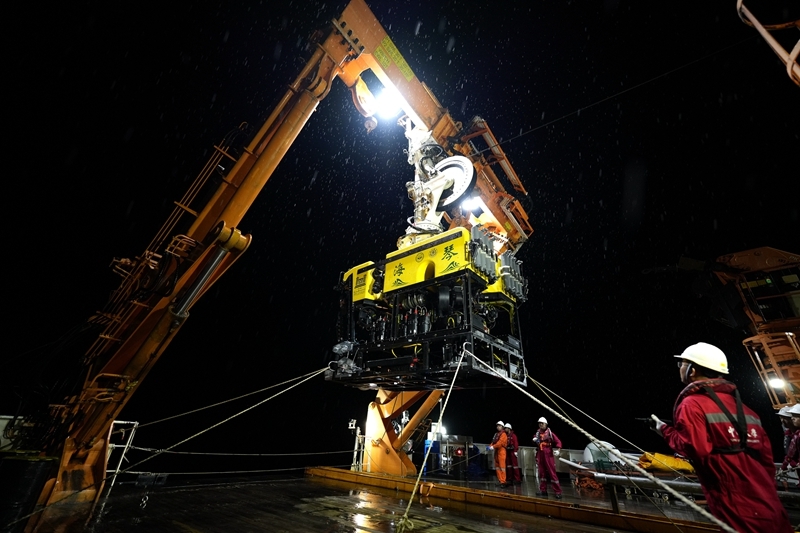
On the evening of August 22nd, the inspection team placed the "Haiqin" on the main deck of the stern of the "Sun Yat sen University" ship in the rain.
On the morning of August 23rd, in the dawn of the South China Sea, China's independently developed 6000 meter deep-sea unmanned remotely operated vehicle (ROV) "Haiqin" successfully conducted a sea trial from a depth of 4140 meters after 8 hours of operation, adding another "scientific research tool" to China's deep-sea research.
The "Haiqin" was independently developed by the Underwater Engineering Research Institute of Shanghai Jiao Tong University. It is a new and efficient deep-sea electric ROV system tailored for the "Sun Yat sen University" marine comprehensive scientific research internship ship. It is equipped with high-definition cameras, multifunctional robotic arms, detection sensors and other scientific research equipment, and has intelligent operation capabilities such as automatic orientation, hovering positioning, and automatic line patrol.
Photo by Xinhua News Agency reporter Zhang Jiansong
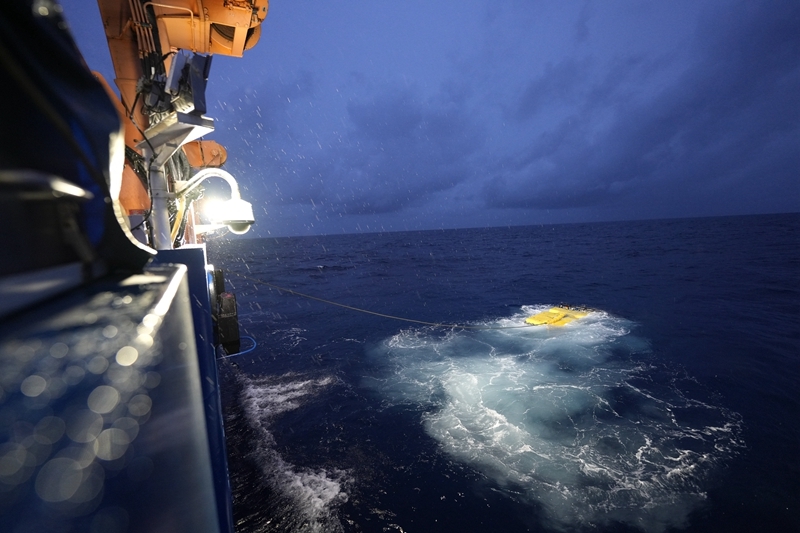
On the morning of August 23rd, the "Haiqin" surfaced from the sea.
On the morning of August 23rd, in the dawn of the South China Sea, China's independently developed 6000 meter deep-sea unmanned remotely operated vehicle (ROV) "Haiqin" successfully conducted a sea trial from a depth of 4140 meters after 8 hours of operation, adding another "scientific research tool" to China's deep-sea research.
The "Haiqin" was independently developed by the Underwater Engineering Research Institute of Shanghai Jiao Tong University. It is a new and efficient deep-sea electric ROV system tailored for the "Sun Yat sen University" marine comprehensive scientific research internship ship. It is equipped with high-definition cameras, multifunctional robotic arms, detection sensors and other scientific research equipment, and has intelligent operation capabilities such as automatic orientation, hovering positioning, and automatic line patrol.
Photo by Xinhua News Agency reporter Zhang Jiansong
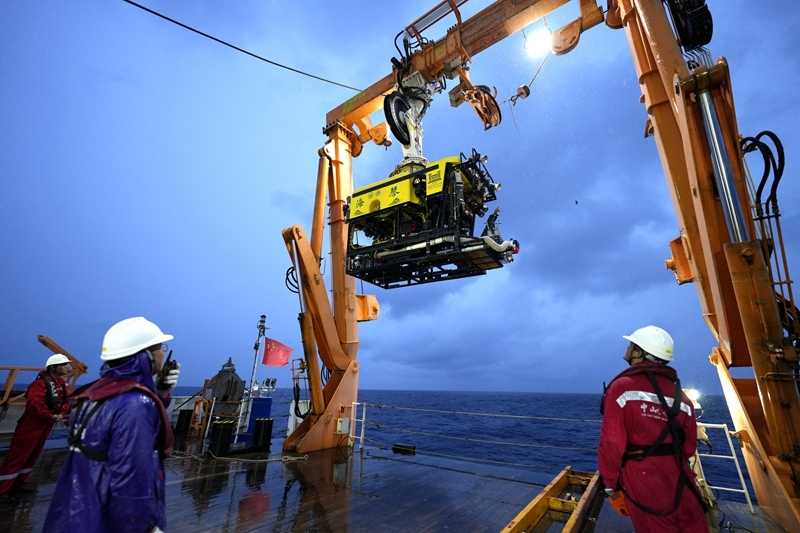
The scene of the "Haiqin" being recovered from the sea captured on the morning of August 23rd.
On the morning of August 23rd, in the dawn of the South China Sea, China's independently developed 6000 meter deep-sea unmanned remotely operated vehicle (ROV) "Haiqin" successfully conducted a sea trial from a depth of 4140 meters after 8 hours of operation, adding another "scientific research tool" to China's deep-sea research.
The "Haiqin" was independently developed by the Underwater Engineering Research Institute of Shanghai Jiao Tong University. It is a new and efficient deep-sea electric ROV system tailored for the "Sun Yat sen University" marine comprehensive scientific research internship ship. It is equipped with high-definition cameras, multifunctional robotic arms, detection sensors and other scientific research equipment, and has intelligent operation capabilities such as automatic orientation, hovering positioning, and automatic line patrol.
Photo by Xinhua News Agency reporter Zhang Jiansong
电话
地址